May 31, 2011

Haiga 593 Matsuo Basho haiku -Geta (wooden shoes)


While I was blogging about Hawaiian things, Basho's journey in the north continued. He was now at Kurobane. He stayed at haijin's house for 13 days, from May 22 through June 2, longest stay at one place in his journey. His intention was to rest and to build enough energy to continue the long journey.

He also visited a temple nearby to pay tribute to the mountain monks who wore the Geta (wooden shoes) with one high tooth, and wondered around the wilderness of mountains to acquire spiritual trainings. He prayed for the success of his long journey.

In this series of haiga, I often draw in various birds, though there is no mentioning of it in the haiku. It kind of symbolizes Basho the traveler.

One tooth Geta

Haiga 594 Kobayashi Issa haiku - mountain and sea


Haiku by Kobayashi Issa. Artwork by myself.

I have been involved with the internet since the early days, when many of us were using slow modems. Images were slow to appear, first with rough mosaic, then a little finer one, and finally the complete image. That is what i applied to this haiga.

As did Issa, I experienced similar situation several times while hiking in Hawaiian mountains. Walked through rain forest, walked on ridges of mountain, for hours, and came to the point where blue expanse of the Pacific ocean opened up before my eyes. How soothing that moments were.

Mountain trek,
too tired to take in anything
but green breeze

May 30, 2011

Hawaiian connection -photo nuts

During my college years, I was mainly studying painting, but my interest extended to ceramic, printmaking, and to photography.

Photography classes were extremely popular and I could not register any one of them so I decided to self-teach the art. I built my own darkroom and learned how to develop film and make prints. I did part time jobs to get my first Minolta, and then Nikon. Wherever I went, I had a camera always with me, dangling from my neck.

I met a few photo nuts on campus, and they all came to my darkroom to do their things. One day, I was in the darkroom with Ronald, a Viet Nam veteran studying chemistry.
"Oh, come on, Ronald, do it outside" I would say, "Protein based fart is killing me."
The darkroom was small, barely enough for two persons so the smell was unbearable.
"Funny. Mine usually smells like plumeria", he mumbled as if I had malfunctioning nose.

Under dim red light,
a nude slowly appears
in developer bath


One beautiful sunny day, we all got on a beaten Volkswagen and went to Kaena Point, north-west end of Oahu. Rugged rocky shore still retained aura of the old primitive Hawaii, of the time long before the islands were settled by outsiders. I got inspired by the scene, and shot many photos, which I later compiled into a hand-made photo book plus an essay. I submitted it to my contemporary art history class as a final assignment.

Standing at a point
where an island ends,
I face the vast ocean

May 29, 2011

Hawaiian connection - painter


I received art training from many teachers while in Hawaii. The first one was Mimi Fujita, who recognized in me something differnt from the other high school students, and treated me special by providing chances to articulate myself visually when I hardly spoke words of English.

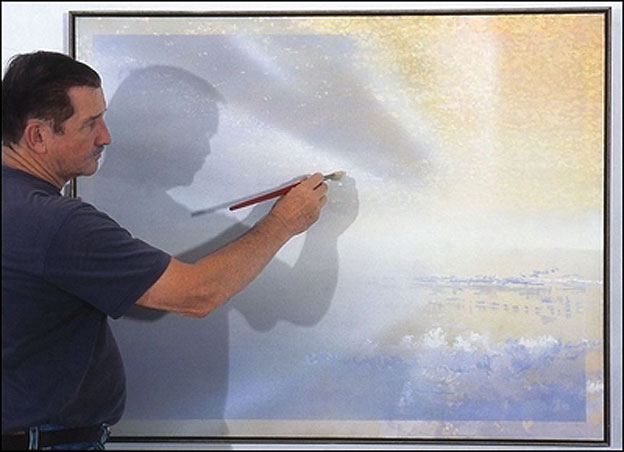
Another teacher is this guy in the photo above. John Wisnosky, my painting teacher at University of Hawaii. He was a good teacher who could see suitable direction for each student.
"Don't do abstract. Figurative is your thing. Look into Andrew Wyeth, Edward Hopper, Ben Shahn..." he used to say to me. I did one painting of chess players in Waikiki in the Impressionist style. He liked it and had it hanged in his office for a long time. Following the direction, the last painting I did was super realistic one, which won a purchase award and became a permanent collection in a museum in Honolulu. The award gave me enough income to finance a trip to the Philippines, Hong Kong, Taiwan, and back to Japan.

I found just today that John had passed away at age of 66, in 2006. I've lost a good connection to Hawaii.

John's other link

Old paint box -
tubes hardened and
a few missing

May 27, 2011

Hawaiian connection - photographer dad


A portrait of Munakata Shiko photographed by Francis Haar. Munakata was a woodblock printmaker, famous for his action-painting like arroach to carving wood block, and was very well known internationally. I even saw his documentary film in my Art 101 class at U of H.

Francis Haar was a distinguished photographer in his homeland, Hungary, and when his wife Irene and he came to Japan, he was treated as such, set up studio and took photos of many celebrities, artists, politicians and so on. They later decided Hawaii would be their retirement home.

I was back to Hawaii again, after 10 years after graduation. Tom san requested my help to put together a large photographic exhibition of his father's past works. The exhibition was held at a building by the Aloha Tower, downtown Honolulu. Later, Francis and Irene invited me for a dinner at their home. The house I visited on St. Louis Heights was Francis's residence.

Before coming to Hawaii, Irene owned a Hungarian restaurant in Ginza,Tokyo, which was frequented by many celebrities. She was a marvelous cook, too, so what I was served then was a superb dinner, which ended with a cup of orange grass tea.

May 26, 2011

Hawaiian connection -photographer son


John Lennon, Yoko Ono, Nam June Paik and Shuya Abe, opening of the Paik exhibition, Galeria Bonino, New York, 23 November 1971 © Tom Haar

I met Tom san in NYC, summer of 1970. I knocked on his apartment door, and he greeted me with a broad Haar smile. Still smiling, he said he had gotten robbed a few days ago, all his Nikkon cameras and lenses gone. In the later years, we met several times, and he always had that Haar smile. When he introduced me his Japanese wife, the smile was even broader.

Tom san was introduced to me by my art instructor (University of Hawaii, Manoa). "Meet this guy when you reach NYC, a promising photographer", he said. I was about to set out on a month-long tour on the mainland America on the Grey Hound Bus. In NYC, Tom san took me around, to a party, to artists' studios in Soho, and to some obscure diner, which reminded me of a Edward Hopper painting (Nighthawks, 1942).

Many years later, when he settled in Hawaii, I visited him at a house with view on St. Louis Heights. That was when I met Francis Haar for the first time. (To be continued)

May 25, 2011

Short story ebook "Worldman"


Some years ago, I wrote a haibun titled "Worldman". This short story has evolved from it. The story is basically a fiction but reveals some experience I had when I was in Hawaii as a young boy.

I converted it into PDF format in Kindle size. You can download it here

May 24, 2011

Haiku 592 Kobayashi Issa haiku - orphan sparrow


Haiku by Kobayashi, Issa. Artwork by myself.

A famous haiku, probably the best known haiku by Issa, practically all school children in Japan know this one. All school children including those who reside in the disaster area, many without parents.

A new scholarship is founded in Japan to support those children. Many NPOs and organizations, including my church, are sending repeatedly crews of experts on children to the area to console affected boys and girls. Time to play and have fun is very precious for them now. They are an important part of the future of this country.

May 22, 2011

Haiku book cover design


This is the image of the cover, spine, back cover of Sayumi Kamakura's haiku book. I made revisions six times and this is more like the end product.

Sayumi's request is to make the design look Matisse like. The publisher allows me to use only two colors for economic reason. With these conditions I began. As for Matisse like thing, I decided to use his paper cut out technique with simple organic shapes and flat colors. I decided to use two colors, black and pink, in various shades to give colorful impression.
The book will be published some time this summer. The publisher is Chuseki-sha of Tokyo.

I made two book covers this month. I love working on the cover designs.

May 21, 2011

Haiga 591 Shinohara Hohsaku haiku - lung


Haiku by Shinohara, Hohsaku (1906-1936 Japan). Artowrk by myself.

Shinohara is noted for his non-season word haiku. He wrote this haiku when he was on a ship, and it was probably not in summer time. The reason I posted this haiga today, in the middle of May, is that it reminds me of a week-long sea trip which took me to Hawaii from Yokohama. I was 15 then, and the expanse of deep marine blue sea of the Pacific Ocean was so overwhelming that I was almost scared, a completely new experience .

I am in a mood to think about Hawaii. I lately read a book called "Lester Higata's 20th Century" by Barbara Hamby. The story takes place in Hawaii and conveys the kind of mood of the locality I remember. It was so good to me that I am reading it for the second time now. I even wrote a thank-you letter to the author, who is also an established poet and teaches at Florida State University. Her story fills my lung with all the memories of my bygone days in Hawaii.

-----
I added "Haiga essay on Hiro Yamagata painting" in the Kuni's link on the right side of this blog. It is in pdf format, and will download when you click the link.

May 20, 2011

Haiku 590 Matsuo Basho haiku -Nikko


Haiku by Matsuo Basho (from the Narrow Road to the Deep North). Artwork by myself.

It was May 19 when Basho reached Nikko, where the shrine of the Tokugawa Shogunate situates, and wrote this haiku. The haiku ends with "hi no hikari" meaning "light of the sun", and this corresponds to the name of the shrine, Nikko Shrine. Nikko means light of the sun. Tokugawa Shogunate ended the long wars among local feudal lords, and brought peaceful time to the whole country of Japan. Basho wrote this haiku to praise the Tokugawa's accomplishment.

Keen eyes might have noticed in this haiga that I am using the same leaves as the one in the previous haiga, Joann Klontz's crutches one. I often use the elements of one haiga for the others. That is one good thing about using computer.

May 19, 2011

Haiku 589 Joann Klontz haiku - crutches


Haiku by Joann Klonz of USA. Artwork by myself.

Another green leaves haiga. Joann's haiku does not have the season word, but I picked this season of green leaves for the haiga. It is the season even a person with leg ailment want to play and roll on fresh green grass, freeing from the binding of the crutches.

I have been checking out a blog run by a person who lives in Ishinomaki city(石巻), one of the severely hit cities by the 3/11 disaster. This blog link shows recent photographs of the city. Though the photos are taken under sunny spring sun light, there is tone of melancholy in all. In a way, they possess a similar feel as this haiga today.

May 18, 2011

Haiga 588 Masajo Suzuki haiku - Nape


Haiku by Masajo Suzuki. Artwork by myself. English translation by Lee Garga & Emiko Miyashita.

Today is such a beautiful day of May.
I had a lecture to make in the morning. On the way, I walked into canopies of young leaves, sun light flicking through them. The air was fresh and crisp. I was not in hurry so stayed there for a while just to enjoy the whole scene.

For the past postings, I showed monochrome haiga works. Considering the season now-new green leaves everywhere, I felt that the monochrome was not really suitable so I decided to post this haiga for a change.

May 17, 2011

Haiga 587 Dimitar Anakiev haiku - Rustic


Haiku by Dimitar Anakiev of Slovenia. Artowrk by myself.

Another haiga I made for Dimitar's anthology. He likes it much, and I am glad. In making a series of haiga for the anthology, I noticed that art of caricature could be a style of haiga. In haiga, what haiku says is reflected on the artwork that is not illustrative, but suggestive of the haiku. I think this haiga way seems to correspond with that of caricature. I used black crayon for this haiga.

-----

Yesterday, May 16, I attended a small gathering in Osaka. We are all interested in Matsuo Basho's "Narrow Road to the Deep North", and we talked about the topic for hours over dinner. This gathering was originally scheduled on May 12, but because something came up, it was postponed to 16th. One of the participants said at one time that this very day, May 16th, is when Basho set out on to the trip, leaving Senjyu, Tokyo by boat. We all felt that Basho san was with us, backing up our project, of which we are going into more concrete steps. Good sign, indeed.

May 16, 2011

Haiga 586 Kaneko Tohta haiku - pencil


Haiku by Kanako, Tohta. Artwork by myself.

I was born 4 years after WW2, so I do not have experience being in a war situation, let alone the air raid. Yet, Kaneko's sharpened pencil conveys the tense moments, which I can imagine, and from the imagination I made this haiga.

I do, however, have experience being affected by a big earthquake, the one occured 16 years ago in Kansai area of Japan. I saw a big city crumbled into pieces, felt tremendous shock. I imagined that being bombed meant probably the same.

Natural disaster is unavoidable, but destructions by human hands could be avoided, be they war, environment, human rights. I am hoping Dimitar Anakiev's anthology will result in a dent, however small, in the world.

May 15, 2011

Haiga 585 Natsuishi Ban'ya haiku -Hiroshima


Haiku by Natsuishi Ban'ya. Artwork by myself.

So much is new to us, from people on the street to officials of power plants and government.
When something goes wrong with the nuke, we really do not know how to confront it. Many seem to underestimate the situation. Many try to hide numbers, which they say for avoiding panic, but many became panic anyway. Many try to save faces. Many have become very nervous. Many simply try to carry on, being conscious of uncertainty this nuke problem entails, and I am one of this last group.

Ban'ya san is one of those nervous ones. Soon after 3/11, he purchased a radiation measuring device, and have it around all the time, checking the measurement everywhere he goes. I cannot really make fun of him for being such paranoia because I am not sure myself how far this uncertainty extends.

Today is another beautiful day of May, sunny, soothing breeze, full of young green leaves. Invisible, intangible, no smelling nuke may or may not be a part of this beautiful scene.

May 14, 2011

Haiga 584 Taneda Santoka haiku - legs and arms


Haiku by Taneda Santoka. Artwork by myself.

My blog, Blogger, was down almost all day yesterday. They said it was because of maintenance, but the real cause maybe something else, like hacking. Blogger is part of the mighty Google so likely to become a target. What happened to Sony recently shows there are skilled people out there to do mischief.

Santoka wrote about a deplorable condition, and he wrote it in such a way that much of its appreciation rested on the reader. Many images came and went in my mind as I tried to make this haiga. A true haiku way, indeed. This haiga will be included in Dimitar Anakiev's anti-war haiku anthology.

I met a free-verse advocate at World Haiku Association gathering. He is one of the key figures in the genre. According to him, recent free-verse haiku are not as powerful and profound like ones by Santoka, Hosai, Sumitaku, and such. He is all for putting in some shock treatment for the genre.

May 12, 2011

Haiga 583 Vladmir Devide haiku - careless


Haiku by Vladmir Devide of Croatia. Artwork by myself.

I exchanged a few correspondences with the late Devide san. One time I made big printouts of the haiga I made for his haiku, and sent them to him. In return he sent me a few haiku books, including a big color book. Devide san's wife is a Japanese. I once saw them on a TV documentary broadcasted in Japan, which was about haiku people in Balkan areas. Devide and his wife appeared to me a good loving couple.

The tyhoon rain seems to have stopped this morning here, but the clouds are still pretty heavy. People walking on the street are taking umbrella along. Small insects, however, are sometimes careless and venture into the poring rain only to be slapped down on the ground.

I heard that when the tsunami was approaching, quite a few people actually went out to the pier or seaside to watch the wave. How careless I thought, but I guess that is what happens when one underestimates the real power of the nature. Being curious and being careful are both the working of the mind. It makes a big difference which working one chooses in time of danger. I certainly choose not to be a careless butterfly.

May 11, 2011

Haiga 582 Ai Li haiku - rain


Haiku by Ai Li of UK. Artwork by myself.

When I left Tokyo yesterday, the sky was heavy with rain clouds. As my bullet train approached Kyoto, rain began to pour. I heard in the news that this rain was brought by the tyhoon, the first one in this year. This means rainy days continues for several days.

Today is thus another rainy day. More humidity in the air. I made printouts of emails containing many haiku and requesting letters, and they all feel damp. It seems the humidity is almost 100 % here.

I already have several project to complete this month, and yet new emails have brought to me more projects: a book cover for a haiku book to be published in Tokyo, and a short article of recommendation for a haiku book to be published in London. It is like in this haiga, I want to relax lying back on a desk chair, but rain keeps me away from the comfort. Nice to be busy, though.

May 7, 2011

Haiga 581 Jim Kacian haiku - history


Haiku by Jim Kacian. Artwork by myself.
Yet another haiga for Anakiev's anthology.
This haiku can be said a typical of Jim'; he often writes haiku in this very simple manner. Simple yet quite condensed, and I like his style. For the haiga, I tried to reflect his style, and to convey its content in simple visual form.

I am in Tokyo again, in rainy Tokyo. I had a lunch with my acquaintance in Nakano area(a little west of Shinjyuku). He said that in this area, there was a shopping mall called "Broadway", which enhouses numerous shops for the "Otaku(nerd or geek)" of various kinds, and is older than Akihabara as far as the mecca of Otaku is concerned. Intriguing.

May 6, 2011

Haiga 580 Casimiro de Britto haiku - a balloon


Haiku by Casimiro de Britto of Portugal. Artwork by myself.
This haiga is another one I made for Dimitar Anakiev's anti-war haiku anthology. The interpretation of what the ballon symbolizes is up to you. Things I noticed are that a balloon, when seen from outside, looks attractive, with all the fancy color and design. Inside, however, is hollow, no content but just air or some type of gas. It pops easily or deflates within a few days. It is inflated and looks big but is actually a small little thing.

I met Casimiro several times in the past. He is an established poet and the head of Pen in Portugal. This is maybe my bias but he is a typical Latin man; each time we met, he was with different girl friend. That means he is an attractive man, and I have that impression. He is more known as a poet, often rumored as a candidate of Nobel Prize for literature, but he loves haiku also and have written many, which are often quite poetic and philosophical.

May 5, 2011

Haiga 579 Ram Krishna Singh haiku


Haiku by Dr. Ram Krishna Singh of India. Artwork by myself.

Dimitar Anakiev of Slovenia emailed me the other day, asking me to do some haiga and cover illustration for the anthology he is putting together. The anthology will have many anti-war haiku from around the world. This haiga is made from one of them. All together, there will be more than 10 artworks so this will keep me busy for a while.

Keeping myself busy in creative work is really a good thing in a time like now, when I feel gloomy by constantly hearing worrisome news of the nuke, of people who had to evacuate from the dangerous zones, and of all the dogs, cats, and livestocks being left behind.

Other than Anakiev project, I am preparing 8 haiga for a literary journal published by a university in Kentucky.
I got a letter from Dr. Hirata yesterday. He publishes an anthology called "Haiku Friends" annually. He invites me again to submit 11 haiku for the new issue. This will keep me busy, too, and I am thankful for all these projects.

May 4, 2011

Haiga 578 Pamela M. Ness haiku - Manhattan


Haiku by Pamela M. Ness (USA). Artwork by myself.

Pamela's haiku here reminds me of the WTC Twin towers. The haiku was written after 9.11, so I assume it is a homage to the towers and what they symbolized, and to the people who were affected by the tragic event. I visited the site a year after, and wrote a long haibun "Egg-shaped Stones".

The guy, who caused the tragedy, has been taken down. Yet, his influence is said to remain. I just hope that there will be no more vicious cycle.The world is getting smaller, becoming more like a village where any antagonism only leads to the destruction of the whole community. We now need a Great Thought, by which we contemplate the question as to why we are living in this world.

May 2, 2011

Haiga 577 Masanori Matsuda haiku-2


Again, haiku by Masanori Matsuda. Photo is by Dave Anderson. I did English translation and digital manipulation of the photo.

David took this photograph after the New Orleans flood caused by Hurricane Katrina in 2005. Though the magnitude differs, what New Orleans experienced resembles the devastation in North East Japan.

After 50 days, there are still more than 130,000 evacuees staying at numerous shelters scattering in the broad areas. Their homes and daily lives had turned from physical to just reflection image on the water surface.
I enhanced the color of the water puddle to make the photo fitting to this haiku.

May 1, 2011

Haiga 576 Masanori Matsuda haiku - Waiting


Haiku by Masanori Matsuda. Artwork & Eng. translation by myself.

I met Matsuda san at WHA Japan conference on 29th. He came from the north, a city called Kitakami in Iwate Prefecture. Though the area fortunately escaped the disaster, he, as an employee at the city hall, has been very busy frequenting the disaster areas to help the restoration works.

In haiku reading session at the conference, he shared with us some haiku he had written while engaging in the restoration works. He wrote his haiku on paper flip boards, and showed them one by one as he read his haiku. That was a good way of presentation because voicing sometimes gets unclear.

He was dressed in dark suit but had on a necktie that looked to be made from Aloha shirts, very colorful and vivid. I liked it much and we hit it off right away. And I promised him to make haiga for his haiku, one of which is what you see here today.